Decision-making is the organising principle.
Start with the decisions that carry real consequences, not with a list of AI use cases. Each decision tells you what information, judgement, authority and safeguards it needs.
Our Approach
Our approach has two parts. A strategy that puts your organisation's important decisions at the centre, and a roadmap for building the capability to make those decisions well, whatever the technology of the day.
Step 1 · Enterprise Reasoning Strategy
AI models, agents and platforms change every few months. The decisions your organisation has to make don't: whether to switch a supplier, approve a loan, enter a market. So the strategy treats those decisions as the fixed point, and Enterprise Reasoning as the capability to build around them.
Start with the decisions that carry real consequences, not with a list of AI use cases. Each decision tells you what information, judgement, authority and safeguards it needs.
Build the ability to bring together what people and machines know into one coherent decision, and to keep that decision intact as it is carried out.
Step 2 · Enterprise Reasoning Capability Roadmap
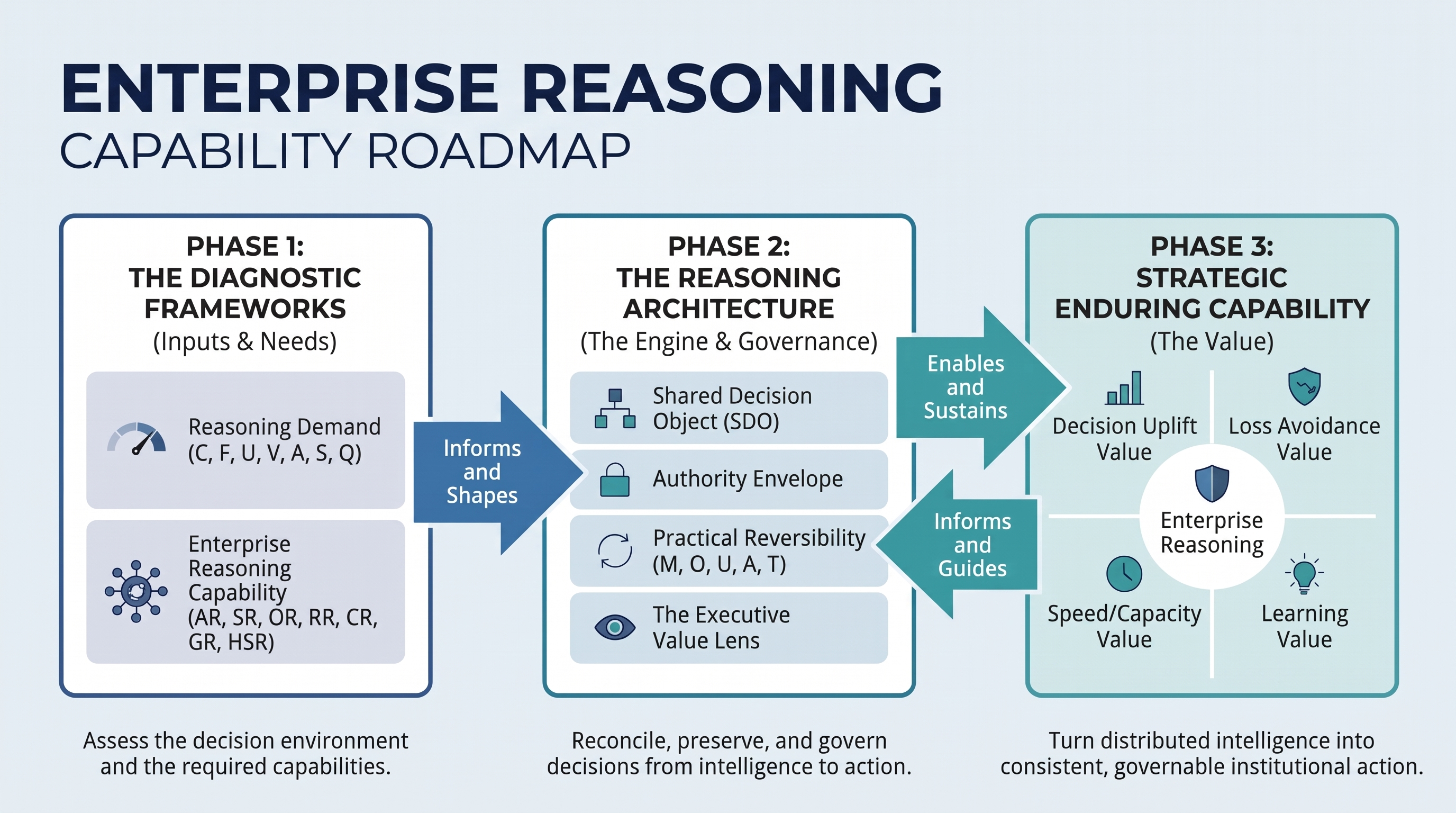
The roadmap has three phases. Work out what a decision needs, build the system that can deliver it, then run that system and keep improving it.
The diagram uses terms and abbreviations from Enterprise Reasoning: The Missing Capability to Become AI-Native, where each one is explained in full. Explore the Book →
The unit of Enterprise Reasoning
A decision class is a kind of decision your organisation makes again and again, such as approving suppliers. It makes a manageable unit of change: each class has its own risks, its own people involved and its own right balance between human judgement and automation. You don't have to change every decision at once, or at the same pace.
Here is what the three phases look like for the supplier decision.
How much conflict, uncertainty and risk does approving a supplier carry? What would it take to decide it well, and how far short of that is the organisation today? This phase finds the gap. It doesn't fill it.
Decide who and what weighs in (buyers, engineers, AI models, rules), how their views are reconciled, who holds final authority, and which safeguards stop a bad approval going through.
Put the new way of deciding into use, check whether supplier decisions actually get better, and feed what you learn back in.
The value comes from all three phases together. A diagnosis on its own changes nothing, and neither does simply deploying a model or an agent. See how to apply the roadmap →