The foundational book
Enterprise Reasoning: The Missing Capability to Become AI-Native by Lawrence Han is an AI 2.0 strategy and capability development roadmap, with governance-by-design built in from the start. It shows how organisations can turn what AI knows into decisions they can stand behind, keep those decisions intact as they become action, and learn from the results as they hand more work to machines.
You'll come away with a strategy for moving beyond one-off AI projects, a way to connect what AI knows to the decisions your organisation makes, and a way to measure what that is worth.
Available on Amazon
English paperback · US$24.99
Japanese edition available in paperback and Kindle formats.
Prices and availability may vary by Amazon marketplace.The gap
Enterprise AI has plenty of frameworks. What it lacks is a fixed point.
Organisations are racing to build AI platforms, deploy agents and redesign workflows. These are sensible investments. The trouble is that the strategy usually follows the technology, and the technology changes before the roadmap is finished.
Every new model brings new use cases, every new architecture invites another redesign, and every new agent promises more automation. Each wave adds something, but the centre of the strategy keeps moving, so nothing holds it together for long.
Start your AI strategy from the decisions that matter, not from the technology. Enterprise Reasoning is the lasting capability you build around them.
How this book differs
Decision classes as the unit of AI transformation
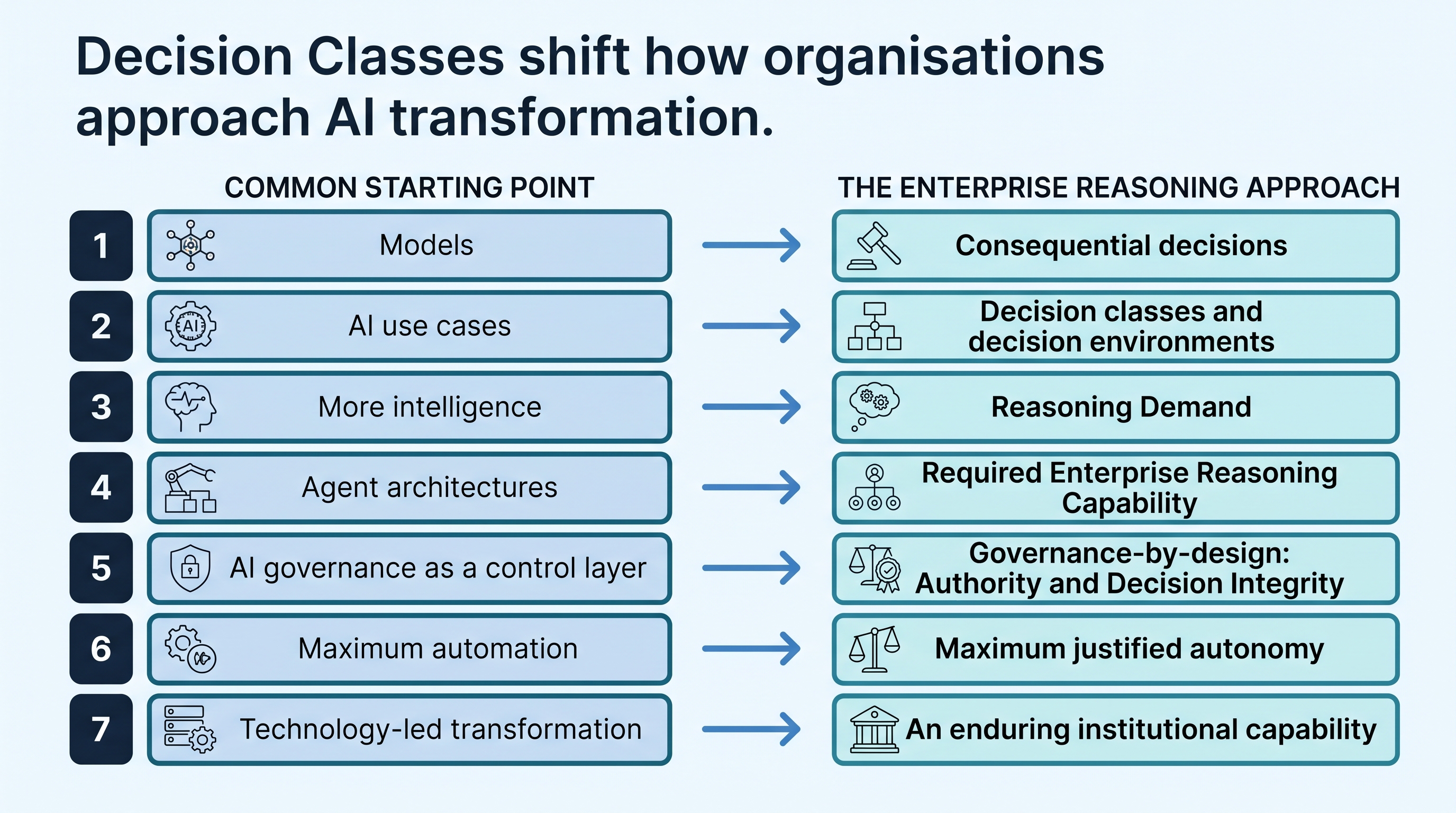
Seven shifts in how organisations approach AI.
Most AI programmes are organised around a model, an agent or a workflow. The book organises them around a decision class instead: a kind of decision the organisation makes again and again, like approving suppliers. For each class you work out what the decision demands, build what's missing, and count the job done only when the whole decision runs well under the right authority. That changes seven things.
Interactive chapter explorer
The argument builds in sequence.
Each chapter answers the question the previous one raises, on the way from having intelligence to being able to reason with it.
01The Enterprise AI Paradox
The question: Why can an organisation become more intelligent without getting any better at deciding?
What you'll discover: The chapter opens with Zillow, the American property company whose AI-powered home valuations helped inform an ambitious home-buying business that was later shut down. From that case comes the Enterprise AI Paradox: having more intelligence doesn't automatically lead to better decisions. You'll see why intelligence alone can't make an organisation AI-native.
02The Enterprise Exists to Reason
The question: Why does an organisation need to reason at all?
What you'll discover: Decisions are how an organisation turns its purpose into action. Yet its departments, people and AI systems often read the same situation in different ways. This chapter shows why an organisation has to reconcile those views into one coherent decision, and why that is its core job.
03The Limits of Intelligence & Reasoning Demand
The question: How much reasoning, and what kind, does a particular decision need?
What you'll discover: This chapter introduces Reasoning Demand: a way to see why some decisions need far more reasoning than others. It looks at seven dimensions (Complexity, Conflict, Uncertainty, Velocity, Autonomy, Scale and Consequence), so you can size up a decision before choosing any technology or designing a solution.
04Decision Integrity
The question: Can the organisation keep what it actually decided intact as the decision is carried out?
What you'll discover: A good decision isn't enough if its meaning changes on the way to action. This chapter introduces Decision Integrity and shows how intent, authority, conditions and limits can be weakened or lost as a decision passes between people and machines, and why protecting them matters for any responsible use of autonomy.
05Enterprise Reasoning
The question: Which reasoning capabilities must the organisation be able to bring together?
What you'll discover: Here Enterprise Reasoning is formally introduced as a lasting capability, along with the Enterprise Reasoning Capability framework. You'll see how different kinds of reasoning contribute to a decision, how Reasoning Demand tells you which ones you need, and why possessing intelligence is not the same as being able to reason with it.
06The Blueprint of the AI-Native Enterprise
The question: What does the organisation's architecture look like?
What you'll discover: This chapter brings the earlier ideas together into a blueprint for an AI-native organisation. It shows how intelligence, reasoning, decisions, authority, execution and learning connect, and what separates an organisation designed to reason from one that simply deploys ever more sophisticated AI.
07Designing the Enterprise Reasoning System
The question: How can specialist roles, human and machine, work together without losing what the organisation means?
What you'll discover: This chapter shows how an Enterprise Reasoning System can be designed in practice: coordinating specialist reasoning, reconciling competing views and keeping a shared record of where the decision stands. You'll see why stitching together AI agents' outputs isn't enough, and how the organisation's meaning can survive collaboration, summarising and execution.
08Governing Autonomous Enterprise Decisions
The question: How much authority should machines get, and under what conditions?
What you'll discover: As AI moves from making recommendations to taking action, governance gets harder. This chapter introduces the Authority Envelope, meaningful human oversight and Practical Reversibility, and shows how governance-by-design keeps the organisation in control while it pursues the most autonomy it can justify, rather than the most automation it can achieve.
09Building the AI-Native Enterprise
The question: How does an organisation turn the framework into real change?
What you'll discover: The final chapter turns Enterprise Reasoning into a practical way to transform. Start with the decision classes that matter, work out what they demand, find the gaps, redesign how those decisions are made and measure the results. You finish with a roadmap for building a lasting capability, instead of chasing one technology-led initiative after another.
